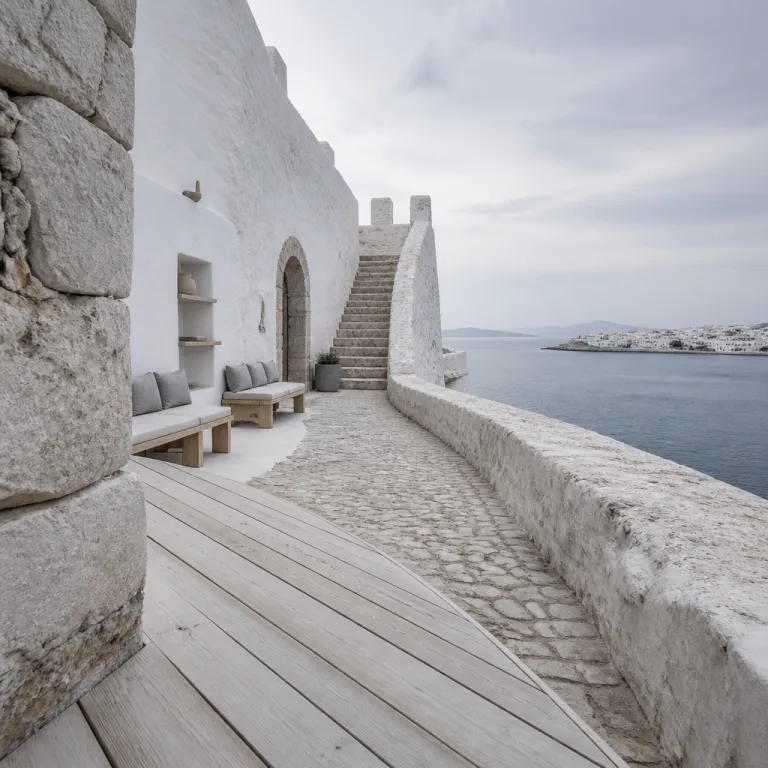
Medieval town planning as hospitality design in the Greek islands
On certain Greek islands, the medieval street plan shapes every stay. Within fortified walls, the way each town was originally built for defense now creates a rare kind of intimacy for guests, where stone lanes, arches and inner courtyards feel like an open air lounge. This is where greek islands medieval architecture historic hotels become less about a single hotel and more about inhabiting an entire historic town.
Walk through a car free greek island stronghold at dusk and you feel how the urban design itself becomes a retreat. Narrow passages funnel the aegean breeze, stone houses lean close, and small squares open suddenly with panoramic views over the aegean sea that no modern infinity pool can quite imitate. Medieval architecture here was built to manage heat, wind and threat ; today, the same planning quietly manages light, privacy and sound for travelers choosing historic hotels over anonymous hotels Europe chains.
For solo travelers, this structure matters more than any single santorini hotel amenity list. You can step from your room in a restored stone house hotel straight into a living museum, then wander to a port taverna rather than a generic boutique lounge. The greek history of siege and trade that shaped these towns now shapes your evening walk, turning every stay into a slow reading of walls, gates and carved rock stairways that lead from sea level to hilltop fortresses.
Rhodes Old Town: sleeping inside a medieval castle city
Rhodes Old Town is one of the purest expressions of greek islands medieval architecture historic hotels. Enclosed by massive walls and towers, this aegean town lets you sleep along the same cobbles once patrolled by the Knights of Saint John, while the modern resort strips outside the walls feel like a different island entirely. Here, the contrast between historic hotels within the fortifications and contemporary hotels Greece along the coast could not be sharper.
Inside the walls, many a former knight’s residence or Ottoman mansion has been carefully built out as a discreet hotel, with thick stone walls, shaded courtyards and wooden galleries overlooking quiet lanes. Some properties sit within sight of Feraklos Castle on the wider island of Rhodes, reminding guests that every stay here is framed by a chain of medieval castle sites, ruined towers and ancient ruins that once guarded the sea routes of Greece. When you choose one of these hotels, you are choosing to inhabit a chapter of Rhodes history rather than merely visit it on a guided tour.
Practicalities matter in a walled town, especially for solo travelers arriving by accessible boat from other greek islands. Luggage often comes in on small electric carts, and you quickly learn the geometry of gates, bastions and squares that define your daily routes between hotel, port and sea facing ramparts. For deeper planning across the archipelago, our guide to where to stay on the most beautiful Greek islands helps you balance a night within Rhodes Old Town’s walls with lighter Cycladic stays elsewhere.
Patmos and Monemvasia: spiritual stone and cinematic arrivals
Patmos and Monemvasia show how greek islands medieval architecture historic hotels can feel almost monastic in their calm. On Patmos, the fortress monastery of Saint John crowns the Chora, and the Cave of the Apocalypse shapes the island’s spiritual atmosphere in a way that seeps into every hotel carved into the hillside. Here, even a modest hotel room with a private terrace feels like a cell in a stone retreat, with views that fall away to the aegean sea.
Monemvasia, technically tethered to the Peloponnese yet experienced as a greek island in spirit, offers one of Greece’s most cinematic check ins. You leave your car on the mainland, walk through a tunnel gate cut into carved rock, and emerge into a walled town where every lane, church and archway has been built to frame the sea and sky. Many of the small hotels here occupy houses originally built for merchants and sailors, their thick stone walls now sheltering guests who value silence, history and the sound of waves below more than any rooftop infinity pool.
For solo travelers, both places reward unhurried wandering and evenings that belong to you alone. You can climb to a ruined medieval castle above Monemvasia or sit on a low wall near Patmos’s Chora, watching the light fade over the aegean while the town settles into a soft murmur. To understand how these experiences contrast with life aboard, read our piece on what a week sailing the Cyclades teaches you about the Greek islands before deciding how many nights to reserve behind the fortress walls.
Beyond whitewash: Santorini, carved rock and living fortresses
Not every greek island conforms to the postcard of white cubes and blue domes, yet even Santorini holds layers that speak directly to greek islands medieval architecture historic hotels. Above the caldera, Skaros Rock rises to around 330 meters, its medieval fortress ruins reminding visitors that this volcanic island was once a defensive outpost as much as a romantic escape. When you stay in a santorini hotel near Imerovigli, you are often sleeping in rooms carved rock into the cliff, a literal expression of architecture fused with geology.
These carved rock suites, often marketed as a form of boutique accommodation, echo the protective instincts of older fortresses even if the language has shifted to luxury. Thick walls moderate temperature, small openings frame panoramic views, and private terraces seem to float above the aegean sea with infinity pool edges that blur water and horizon. For a deeper sense of how Santorini’s culinary and architectural ambitions intersect, our feature on Santorini’s culinary ambition beyond the caldera view pairs well with any hotel search here.
Elsewhere in Greece, the Poseidonion Grand Hotel on Spetses shows how early twentieth century grandeur can sit comfortably within a historic town fabric. With 55 rooms, it stands as one of the oldest landmark hotels Greece offers on an island, its seafront façade facing the same sea routes once patrolled by warships and trading vessels. “Poseidonion Grand Hotel, established in 1914.” anchors Spetses firmly in the story of historic hotels that treat the town itself as an extension of the lobby.
How to choose and book greek islands medieval architecture historic hotels
Choosing among greek islands medieval architecture historic hotels starts with deciding how much history you want in your daily routine. A hotel inside Rhodes Old Town or Monemvasia’s walls means committing to stone lanes, steps and occasional noise from tavernas, while a property just outside the walls offers easier vehicle access and more conventional resort layouts. Solo travelers often prefer the former, valuing walkability, accidental encounters and the feeling that the town belongs to them after day trippers leave.
Look closely at how each hotel describes its building and surroundings, paying attention to phrases like originally built as a mansion, converted from a monastery or restored from a medieval castle outpost. These details signal whether you are booking into a structure with genuine rich history or a newer build styled to imitate it, and they matter if you care about staying in authentic historic hotels rather than themed replicas. Check whether arrival is fully accessible boat to port or requires a steep walk, and whether rooms offer sea views, courtyard calm or direct sightlines to ancient ruins and fortress walls.
Finally, consider how you like to inhabit space. Some travelers want a compact stone room with thick walls and a tiny window, others prefer a suite with a private terrace, lounge style seating and open views across the aegean. Either way, the most rewarding hotels Europe wide in this niche are those where the architecture, the town and the surrounding sea feel inseparable, turning every stay into a lived chapter of Greek history rather than a simple night in a room.
FAQ
Which Greek islands are best for medieval architecture and historic hotels ?
Rhodes, Patmos and Monemvasia are the strongest choices for greek islands medieval architecture historic hotels. Rhodes Old Town offers a full walled city with many hotels inside the fortifications, while Patmos and Monemvasia provide more intimate stone built settlements. Santorini adds carved rock architecture around Skaros Rock, though its atmosphere is more volcanic cliffside than fortress town.
Is it practical to stay inside Rhodes Old Town’s medieval walls ?
Staying inside Rhodes Old Town is very practical if you are comfortable walking on uneven stone streets. Cars do not enter many lanes, so luggage is often moved by small carts from the nearest gate, but distances are short and the town is compact. You gain immediate access to history, tavernas and sea facing ramparts, which outweigh the minor logistical quirks for most travelers.
How does a historic hotel stay differ from a modern resort in Greece ?
A stay in a historic hotel within a medieval town centers on architecture, atmosphere and walkability rather than large pools and extensive facilities. Rooms may be smaller or irregular because they follow original walls, but you gain courtyards, arches and direct contact with local life just outside your door. Modern resorts outside the walls usually offer easier access, larger infinity pools and more standardized layouts, but less immersion in Greek history.
Do I need to book greek islands medieval architecture historic hotels far in advance ?
Booking ahead is strongly recommended because many greek islands medieval architecture historic hotels have only a handful of rooms. Properties in Rhodes Old Town, Patmos Chora and Monemvasia often fill quickly during peak months, especially those with the best sea views or private terraces. Reserving early also gives you time to coordinate arrival by accessible boat or transfer, which can be more complex than reaching a large resort.
Are these historic towns suitable for solo travelers ?
Yes, walled towns and fortress settlements in Greece are particularly rewarding for solo travelers. Their compact scale, pedestrian lanes and active local communities create a sense of safety and easy orientation, while evenings in the town feel personal and unhurried. You can move between hotel, port and sea walls on foot, letting the medieval layout guide your own rhythm rather than a resort schedule.